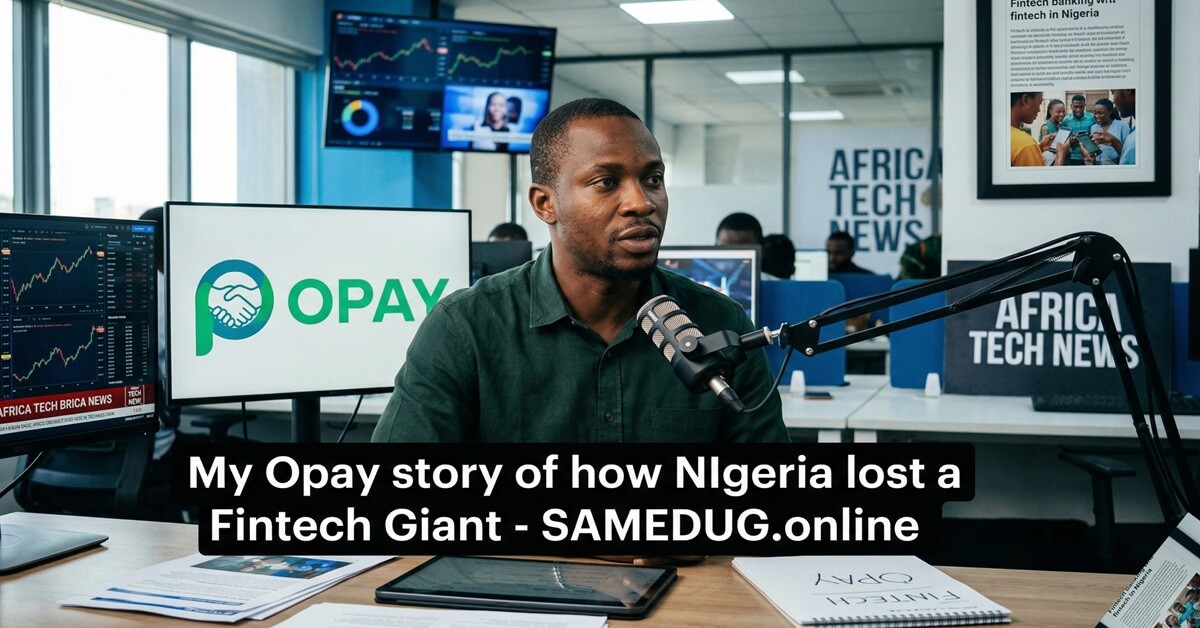
From PayCom to OPay: How Nigeria Watched a Fintech Giant Slip and Scale
I didn’t learn about OPay from a report or a tweet.
I watched it happen in real life. From roadside kiosks to busy junctions, from students running POS machines to traders relying on instant transfers – I saw how something small, almost unnoticed, turned into one of the most dominant financial platforms in Nigeria.
But what many people don’t realize is this:
Before OPay, there was PayCom and before the scale, there was a financial struggle a baby Nigeria company Paycom quietly lost to a Chinese billionaire.
This is a story that have always left me wondering what exactly do Nigeria Billionaires do with money? And even beyond private wealth, what does the Nigerian government truly prioritize with the resources at its disposal?
How the Transition from PayCom to Opay happened
Paycom was built by Telnet Nigeria Limited around 2013. Take note, PayCom had already laid down:
- Payment infrastructure
- Regulatory licensing
- Early integrations within Nigeria’s financial system
At a time when digital payments were still gaining trust, PayCom was doing the hard work – building the rails.
And from my perspective back then, nothing felt broken. It just wasn’t scaling.
Then came the CBN regulation that stifled innovation.
Around 2018, the Central Bank of Nigeria introduced stricter requirements for mobile money operators – including heavy capital thresholds reportedly running into billions.
For a company like PayCom, this wasn’t just a guideline.
It was a wall.
And this is something I’ve come to understand deeply:
Sometimes, innovation doesn’t fail because it’s weak, it fails because the environment demands more than it can realistically give.
PayCom had the infrastructure.
It had local relevance.
But it didn’t have access to that level of capital.
Faced with this pressure, PayCom had two choices:
- Raise an enormous amount of capital locally
- Or find a strategic partner aligned with its vision
That’s when Opera showed up.
And from where I stand today, it’s clear:
Opera didn’t just arrive, it arrived at the exact moment PayCom needed an exit.
They acquired control, and just like that, the foundation of a Nigerian-built financial system began
transitioning into something much bigger and no longer fully local.
I want to highlight at this point that this is the dilemma of most Nigerian innovators. We often encounter financial regulatory bottlenecks that stifle innovation and holds us back from scaling. Now guess who acquired Paycom, it was a consortium of Chinese investors led by billionaire Zhou Yahui – the chairman and CEO of Opera at the time.
This raises an important question: does Nigeria lack billionaires, or is their a shortage of visionary investors willing to back ventures like Paycom?
The Transformation: Capital Meets Infrastructure
After the transition into OPay, I started noticing changes, not slowly, but rapidly. The platform evolved into a modern, high-performance
fintech system, including:
- Migration toward microservices-based architecture
- Adoption of cloud-native infrastructure
- Systems built for auto-scaling under heavy load
- High concurrency transaction handling
- Stronger, more sophisticated security layers
This wasn’t just a technological upgrade.
It was a complete rebuild for scale.
And this is something I couldn’t ignore:
The same infrastructure that struggled to grow suddenly had the resources to become almost
unstoppable.
What Changed Wasn’t Just Technology
Yes, the tech improved.
But more importantly:
The constraints disappeared.
With access to deep international capital and global execution strategy, OPay could now:
- Build without hesitation
- Scale without waiting
- Expand without limits
This was something PayCom, under its original structure, simply didn’t have.
What I Saw on the Streets
Then came the part everyone noticed. OPay didn’t just grow, it spread.
- POS machines became common on every street
- Small vendors became financial service providers
- The unbanked in rural areas started getting banked
- Everyday transactions moved into digital channels
It wasn’t a tech story anymore.
It became a street-level financial revolution.
And I witnessed that shift in real time.
A Hard Truth About Innovation in Nigeria
Looking back, one thing stands out clearly to me:
Regulatory pressure, when not balanced, can quietly push innovation out instead of growing it within.
The same system that could have scaled as a Nigerian success story:
Faced capital barriers
Lost control
And was rebuilt with foreign backing
This isn’t about blame.
It’s about understanding the thin line between innovation and scaling which is funding. In many ways, this is a lesson in missed opportunity where capital exists but the vision to deploy it effectively is often lacking. Now be my guest and guess how much Opera injected into Opay in the first 6 months of its takeover… a whopping $170 Million. After that, another $400 Million was injected in another round led by softBank Vision Fund 2.
Here is another interesting angle, do you know it took OPay approximately 5 years to become profitable in May 2024? This is why capital must be patient!! Innovators dont need capital that is in a hurry to make profit. Investors must be strategic and align to the vision of the project.
Today, OPay processes millions of transactions daily and powers a large part of Nigeria’s informal financial system.
But behind that success is a layered story:
- A Nigerian-built foundation (PayCom)
- A regulatory turning point
- A timely acquisition
- And massive foreign capital and technical scaling.
